Quantum Computing Project Management: Training, Architecture, Cloud Tools and Implementation Strategies

November 24, 2026 · 4 reads
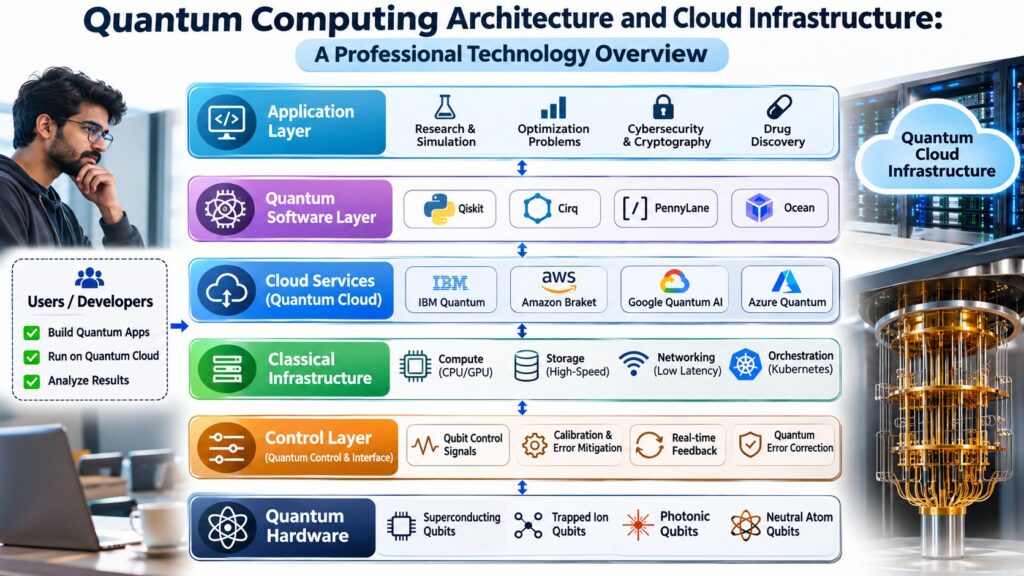
1. Introduction: Turning Quantum Computing Knowledge into Practical Projects
Quantum computing is moving from academic research into technical exploration and business planning. Many organisations now want to understand its possible uses. However, learning the theory is only one part of the process.
A successful project also needs clear goals, suitable tools, skilled people, and a reliable testing process. Teams must understand what quantum computers can do today. They must also recognise their current limitations.
For example, a software team may want to explore optimisation problems. An IT department may want to study quantum cloud platforms. A technical manager may need to evaluate training options and project costs.
Each situation needs a different approach.
This guide explains how professionals can organise quantum computing learning and implementation projects. It covers ten important training and technology areas. Each section focuses on practical decisions, useful activities, and measurable outcomes.
2. Start with a Clear Quantum Computing Project Plan
Before choosing a course or platform, define the problem. A project without a clear objective can become an expensive learning exercise with no useful outcome.
Use the following planning process.
2.1 Identify the business or technical problem
Write down the problem your team wants to explore.
Consider questions such as:
- Does the problem involve optimisation or complex search?
- Can a classical computer already solve it efficiently?
- Does the problem have a suitable mathematical representation?
- Can the team create a small test case?
- What result would make the experiment useful?
Do not select a quantum approach simply because the technology sounds advanced.
2.2 Define measurable project outcomes
Set practical targets before starting development.
For example, a team might aim to build a small optimisation experiment. It could compare a classical solution with a quantum-inspired or quantum-assisted approach.
The team should record execution time, solution quality, resource use, and other relevant measurements.
2.3 Divide the project into stages
A structured project can follow six stages:
- Problem discovery.
- Technical suitability assessment.
- Training and environment preparation.
- Circuit or algorithm development.
- Testing and comparison.
- Final evaluation and documentation.
Each stage should produce a clear deliverable. This makes progress easier to review.
3. Ten Important Quantum Computing Training and Technology Areas
3.1 Quantum Cloud Computing Training
Quantum cloud computing training helps professionals work with quantum computing resources through cloud-based platforms.
It introduces remote access to simulators and supported quantum hardware. Students can develop circuits, submit experiments, inspect results, and compare different execution environments.
For a technical team, the main goal should be to create a controlled learning environment.
What should the training cover?
- Quantum computing fundamentals.
- Cloud access and account configuration.
- Circuit creation and execution.
- Simulator and hardware differences.
- Job submission and result collection.
- Basic resource and cost management.
Practical team workflow
Start by creating a small learning environment. Assign each participant a separate task or account role where the platform supports it.
Next, run a simple circuit on a simulator. Record the circuit configuration and output.
Then, check whether the same experiment can run on supported quantum hardware. Compare the results and identify differences.
Maintain an experiment log containing the date, circuit details, backend, execution settings, and output.
Expected project deliverable
A cloud laboratory document should explain the environment, access requirements, experiments, results, and known limitations.
This makes quantum cloud computing training useful for developers, researchers, and cloud engineering teams.
3.2 Quantum Computing Certification Course
A quantum computing certification course can provide a structured way to learn and assess technical knowledge.
However, a course certificate does not automatically prove practical skill. Learners should examine the syllabus, assessments, instructor experience, and practical exercises before selecting a programme.
Important learning areas
A well-designed course may include:
- Qubits and quantum states.
- Superposition and entanglement.
- Quantum gates and circuits.
- Measurement and probability.
- Quantum algorithms.
- Quantum programming frameworks.
- Cloud-based experiments.
- Error correction concepts.
How to evaluate a course
First, check whether the course defines specific learning outcomes.
Second, review the practical assignments. A course should give learners opportunities to create and test circuits.
Third, understand the assessment method. A quiz can test theory, while a practical project can demonstrate implementation skills.
Finally, confirm the certificate issuer and its recognition. Do not assume that every certificate represents an accredited professional qualification.
Practical assessment example
Ask learners to build a circuit, explain its gate sequence, execute it on a simulator, and interpret its measurement results.
This assessment provides stronger evidence of learning than attendance alone.
3.3 QuantumOps Certification
QuantumOps certification can be considered in the context of operational knowledge for quantum computing workflows.
The term may describe a specific branded learning programme. Its recognition depends on the issuing organisation, assessment process, and credential requirements. Professionals should verify these details before treating it as an industry-recognised certification.
For a technical team, operational knowledge is especially important. A working circuit is only one part of a larger system.
Teams also need to manage jobs, execution errors, dependencies, access, and experiment records.
Important operational skills
- Preparing a repeatable experiment.
- Managing project dependencies.
- Recording execution configurations.
- Monitoring submitted jobs.
- Handling failed or incomplete runs.
- Documenting test results.
- Managing access to cloud resources.
Practical workflow
Suppose a developer submits a circuit that fails during execution.
The team should record the error, check the circuit configuration, review backend compatibility, and inspect the job status.
After making a correction, the developer should run the experiment again. The team should preserve both the failed and successful results.
This practice helps engineers understand why an experiment failed instead of simply replacing the code.
Expected project deliverable
Create an operational runbook covering setup, execution, common failures, recovery steps, and result documentation.
3.4 Qiskit Programming Course
A Qiskit programming course helps developers understand quantum circuit development through a widely used open-source quantum software framework.
It provides a practical environment for learning circuit construction, gate operations, simulation, measurement, and backend execution.
Software engineers should focus on the complete development process rather than memorising individual commands.
Important programming topics
- Quantum circuit creation.
- Qubit and classical bit registers.
- Quantum gate operations.
- Measurement and result interpretation.
- Circuit simulation.
- Circuit transpilation.
- Backend configuration.
- Experiment testing.
Practical development process
Begin with a small circuit that creates a superposition.
Apply a Hadamard gate to an initial qubit. Measure the output over repeated runs.
In an ideal simulator, the measurement results should approach an even distribution between zero and one. Individual runs may still differ.
Next, add a second qubit and create a simple entangled circuit. Study how controlled operations affect measurement results.
Then, use a transpiler to prepare the circuit for a selected backend. The transpiler may change the circuit structure to match the target device’s supported gates and connectivity.
Software engineering practices
Keep project dependencies documented. Store circuit code in version control. Add tests for expected circuit behaviour.
Record the simulator or backend used during each experiment. These details make results easier to reproduce.
3.5 AWS Braket Training
AWS Braket training introduces developers to a managed environment for quantum computing experiments.
It helps learners understand how to develop circuits, use simulators, submit tasks, and work with supported quantum devices.
Training should explain the full execution process, not just the interface.
Topics to study
- Quantum circuit development.
- Managed quantum simulators.
- Supported quantum hardware.
- Task submission and monitoring.
- Device selection.
- Experiment result handling.
- Hybrid job workflows.
- Cloud permissions and cost controls.
Practical implementation workflow
Start with a small circuit on a simulator. Check the output and confirm that the experiment behaves as expected.
Next, inspect the available device information. Compare device requirements before selecting a hardware backend.
Submit a small experiment when the chosen device supports the circuit. Monitor its status and record the returned results.
Keep an execution record with the circuit, device, task information, configuration, and output.
Cost and resource planning
Cloud experiments may involve service charges. Costs and availability depend on the selected resources and current service terms.
Set spending limits where available. Use small experiments during early development.
A team should understand the cost of each test before increasing its execution volume.
3.6 Quantum Computing for Software Engineers
Quantum computing for software engineers focuses on applying existing development skills to quantum programming.
Software engineers already understand functions, data structures, testing, version control, and system integration. These skills provide a useful foundation.
However, quantum programming introduces different ways to represent information and execute computations.
Skills developers should build
- Understanding quantum states.
- Creating and testing circuits.
- Working with quantum programming frameworks.
- Understanding circuit measurement.
- Learning algorithmic limitations.
- Connecting classical applications with quantum workflows.
- Managing dependencies and experiment versions.
Practical software development approach
Choose a small problem with a clear input and expected output.
Create a classical version first. This gives the team a baseline for comparison.
Then, investigate whether a quantum formulation is suitable. Break the implementation into separate modules.
For example, one module can prepare input data. Another can construct a circuit. A third can submit the experiment and collect results.
The final module can compare the output with the classical baseline.
Why this approach matters
Developers can test each component independently. They can also identify whether a problem comes from data preparation, circuit construction, backend execution, or result processing.
A structured software workflow makes quantum experiments easier to maintain.
3.7 Quantum Computing Architecture Course
A quantum computing architecture course helps learners understand how different components work together.
Architecture knowledge matters when a team must design a system instead of building a single circuit.
A typical quantum application may include a user interface, classical application logic, data preparation, quantum circuit development, backend services, and result processing.
Important architecture areas
- Application and service layers.
- Quantum circuit components.
- Classical processing systems.
- Cloud service integration.
- Hardware and simulator interfaces.
- Data movement.
- Security and access controls.
- Monitoring and logging.
How to design an architecture
Start with the application requirements. Identify which components need classical computing and which components may use quantum resources.
Next, create a logical architecture diagram.
Show how the application prepares data, creates a circuit, submits a job, receives the result, and processes the output.
Then, identify external dependencies. These may include cloud services, programming frameworks, authentication, and storage.
Finally, document system limitations. Hardware access, circuit compatibility, execution time, and service availability can affect the design.
Expected project deliverable
Create an architecture document with component descriptions, data flows, interfaces, dependencies, security considerations, and failure-handling methods.
3.8 Hybrid Quantum Classical Computing Training
Hybrid quantum classical computing training focuses on applications that combine classical computing with quantum processing.
This approach is important because many quantum algorithms rely on classical systems for data preparation, optimisation, and result analysis.
For example, a variational quantum algorithm can use a classical optimiser to update circuit parameters. The quantum circuit then produces measurements that help guide the next iteration.
What learners should understand
- Classical data preparation.
- Parameterised quantum circuits.
- Circuit execution.
- Measurement result collection.
- Classical optimisation.
- Iteration management.
- Performance evaluation.
Practical workflow
First, define the problem and prepare a small dataset or mathematical representation.
Next, create a parameterised circuit. Select an objective function that measures the quality of the result.
Then, execute the circuit and collect measurements.
Pass the results to a classical optimiser. The optimiser updates the circuit parameters.
Repeat the process until the stopping condition is reached.
What should the team measure?
Record the number of iterations, execution time, objective value, resource use, and final solution quality.
Compare these measurements with an appropriate classical method.
This comparison helps the team determine whether the hybrid approach provides a useful benefit for the selected problem.
3.9 Quantum Computing Consulting Services
Quantum computing consulting services can help organisations assess opportunities and plan technical experiments.
A consulting engagement should begin with a business problem. It should not begin with a promise that quantum computing will improve every process.
Different problems have different technical requirements. Some may be suitable for classical optimisation. Others may justify a small quantum computing investigation.
What a consulting engagement may include
- Business and technical discovery.
- Use-case assessment.
- Feasibility analysis.
- Technology selection.
- Architecture planning.
- Proof-of-concept development.
- Testing and performance comparison.
- Implementation recommendations.
A practical consulting process
Start with a discovery workshop. Ask stakeholders to explain the current system, its limitations, and the desired outcome.
Next, identify candidate problems. Evaluate their mathematical structure and existing classical solutions.
Choose one small use case for a proof of concept.
Define the experiment before development begins. Set success criteria, testing conditions, resource limits, and reporting requirements.
After testing, present the results honestly. Explain what worked, what failed, and what still needs investigation.
Expected consulting deliverable
A useful final report should include the problem statement, proposed architecture, experiment results, limitations, cost considerations, and recommended next steps.
3.10 Quantum Computing for IT Managers
Quantum computing for IT managers focuses on planning, governance, budgets, teams, and technology decisions.
Managers do not need to write every quantum circuit. They do need enough technical knowledge to evaluate project proposals and manage expectations.
The main responsibility is to connect technical experiments with business priorities.
Important management topics
- Quantum computing fundamentals.
- Use-case selection.
- Training and team development.
- Cloud resource planning.
- Security and access management.
- Vendor and platform evaluation.
- Budget control.
- Project risk management.
- Progress reporting.
A practical management framework
First, appoint a technical lead. Define the responsibilities of developers, cloud engineers, researchers, and business stakeholders.
Second, approve a limited exploration budget.
Third, select a small number of measurable experiments. Avoid starting several unrelated projects without clear objectives.
Fourth, introduce review points. Ask the team to report results, blockers, spending, and technical limitations.
Finally, make a decision based on evidence. Continue, redesign, pause, or close the project depending on its findings.
Expected management deliverable
Prepare a project status report that includes objectives, spending, milestones, risks, experiment results, and the next decision required.
4. Build a Repeatable Quantum Computing Project Workflow
Training becomes more useful when learners follow a repeatable process.
A standard workflow also helps organisations compare experiments across teams.
4.1 Stage One: Record the problem
Write a short problem statement. Include the existing method, expected result, and reason for exploring quantum computing.
Avoid broad statements such as “use quantum computing to improve operations.”
A better statement identifies a specific optimisation, simulation, or research problem.
4.2 Stage Two: Establish a classical baseline
Build or identify a suitable classical method.
Record its output, execution time, and resource requirements. This creates a reference point for later testing.
Without a baseline, the team may struggle to judge whether a quantum experiment offers practical value.
4.3 Stage Three: Select tools and learning resources
Choose a programming framework, simulator, and cloud environment based on project requirements.
Check compatibility and access conditions before development.
Provide training that matches the team’s actual responsibilities.
4.4 Stage Four: Develop a small experiment
Keep the first experiment limited.
Test individual components before connecting them into a larger workflow.
Store the code, configurations, and input data in a controlled project repository.
4.5 Stage Five: Test and document results
Run experiments under defined conditions.
Record the environment, backend, execution settings, output, and errors.
Repeat tests where necessary. Avoid drawing broad conclusions from a single execution.
4.6 Stage Six: Review the evidence
Compare results with the classical baseline.
Review technical feasibility, operational requirements, cost, and potential business value.
The final review should explain whether the team has enough evidence to continue.
5. Essential Project Governance and Documentation
Quantum computing projects need good documentation. Quantum hardware, simulators, and cloud services can introduce different constraints.
A result may be difficult to reproduce when the team does not record its environment.
Use a shared project record with these details:
| Record | Information to capture |
|---|---|
| Project objective | Problem and expected outcome |
| Circuit version | Source code and version |
| Environment | Framework and dependency versions |
| Execution target | Simulator or hardware backend |
| Configuration | Circuit and job settings |
| Test results | Measurements and output |
| Errors | Failures and corrective actions |
| Resource use | Execution volume and relevant costs |
| Review decision | Continue, change, pause, or close |
Managers should also define who can access cloud resources and who can approve spending.
Technical leads should review experiment quality. Project owners should maintain decision records.
These practices improve accountability and make project results easier to understand.
6. How to Measure Learning and Project Readiness
Course completion alone does not show whether a learner can work on a real project.
Use practical evidence to assess progress.
6.1 Test conceptual understanding
Ask learners to explain qubits, gates, superposition, entanglement, and measurement in their own words.
They should also understand the difference between a theoretical quantum state and a measured result.
6.2 Review programming ability
Ask learners to build a small circuit and explain its expected behaviour.
Review their code structure, comments, tests, and execution records.
6.3 Check platform knowledge
Ask learners to explain how they select a simulator or hardware backend.
They should understand basic access requirements, job execution, and result collection.
6.4 Evaluate problem-solving ability
Give learners a small technical problem.
Ask them to identify its inputs, desired output, possible classical solution, and potential quantum approach.
The quality of their reasoning matters more than the size of the circuit.
6.5 Review project documentation
A capable learner should be able to explain what they built, how they tested it, what results they received, and what limitations they found.
7. Common Mistakes in Quantum Computing Projects
Teams can waste time when they skip planning or misunderstand the technology.
Watch for these common mistakes:
Choosing technology before defining the problem: A quantum platform should support a clear experiment. The team should not force every technical challenge into a quantum solution.
Ignoring classical alternatives: Always study whether a classical method can solve the problem effectively.
Confusing simulation with hardware performance: A simulator and a physical quantum processor have different characteristics. Their results may not match exactly.
Ignoring noise and hardware limitations: Real quantum devices can produce errors. Circuit depth, connectivity, and hardware quality affect execution.
Selecting courses without checking assessments: Review practical work and learning outcomes before choosing a programme.
Failing to document experiments: Store code, configurations, execution records, and results.
Expecting immediate business benefits: Early projects often focus on learning and feasibility. They should not promise commercial advantage without evidence.
8. Final Thoughts
Quantum computing projects need more than programming knowledge. They require careful planning, practical training, suitable cloud tools, architecture design, and honest performance evaluation.
Professionals should begin with a well-defined problem. They should build a classical baseline, select an appropriate quantum approach, and run small experiments.
Developers can focus on circuit programming and software integration. Cloud engineers can study execution environments and resource controls. Architects can design system components. Managers can guide budgets, team development, and project decisions.
Most importantly, teams should document what they learn. A successful experiment does not need to prove that quantum computing is better. It needs to produce reliable evidence that helps the organisation make its next technical decision.
9. Frequently Asked Questions
9.1 What is quantum cloud computing training?
Quantum cloud computing training teaches learners to access quantum simulators and supported hardware through cloud platforms. It covers circuit development, execution, result analysis, and resource management.
9.2 Who should take a quantum computing certification course?
Software developers, researchers, students, cloud engineers, and technology professionals can explore these courses. The right programme depends on their existing knowledge and learning goals.
9.3 Is QuantumOps certification an accredited qualification?
The answer depends on the specific issuing organisation and credential. Learners should verify the issuer, assessment method, and recognition before describing it as an accredited qualification.
9.4 Why should software engineers learn Qiskit?
Qiskit gives developers a practical way to build and test quantum circuits. It also helps them understand circuit measurement, simulation, and execution workflows.
9.5 What can learners do after AWS Braket training?
Learners can gain experience with quantum circuits, simulators, supported devices, task submission, and hybrid workflows. Practical ability depends on the exercises and projects they complete.
9.6 Does quantum computing replace classical software development?
No. Quantum applications still rely on classical systems for many tasks, including data preparation, application logic, optimisation, and result processing.
9.7 What does a quantum computing architecture course teach?
It explains how application services, classical components, quantum circuits, cloud platforms, and hardware interfaces work together. It also covers data flow and system requirements.
9.8 What is hybrid quantum classical computing?
It combines classical processing with quantum execution. A classical system may prepare data or optimise parameters, while a quantum circuit performs a specific computational task.
9.9 When should an organisation use quantum computing consulting services?
An organisation can consider consulting when it needs to assess a potential use case, evaluate technical feasibility, plan a proof of concept, or understand implementation requirements.
9.10 What should IT managers consider before starting a quantum computing project?
Managers should review the problem, business purpose, training needs, platform requirements, budget, security, risks, and evaluation criteria. They should also set realistic expectations.
Leave a Reply