A Practical Roadmap to Airline Pilot Training and Aviation Careers

November 17, 2026 · 14 reads
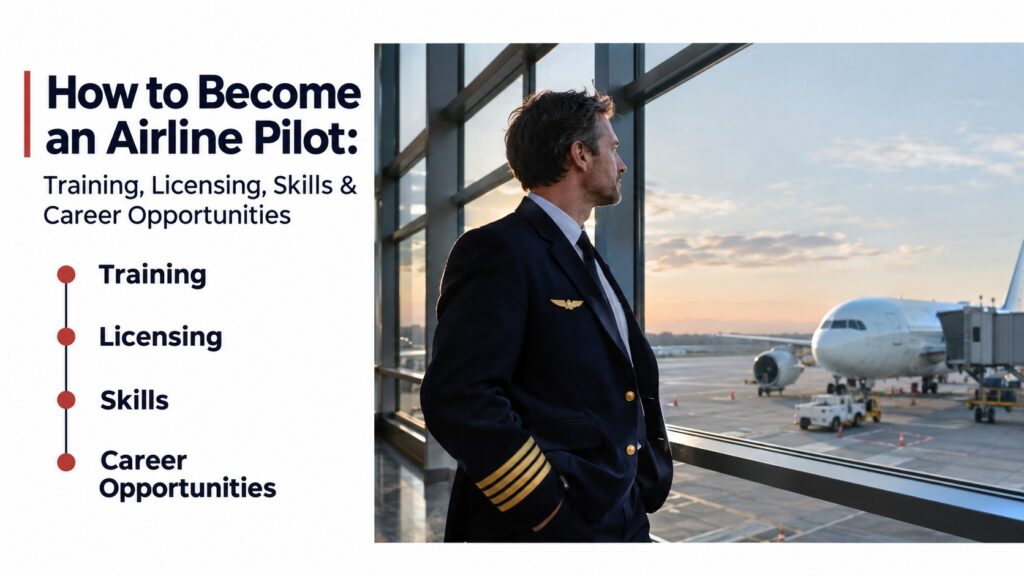
Introduction
A career in aviation begins with curiosity, but it grows through learning, practice, and discipline. Some people dream of flying passenger aircraft. Others want to explore space or work in aerospace science. Both paths offer exciting opportunities, but each requires a different set of skills.
Becoming an airline pilot takes more than learning to control an aircraft. You must understand flight rules, navigation, weather, aircraft systems, and passenger safety. You also need the right licences and enough practical experience.
This guide explains the main stages of pilot training. It also explores astronaut careers, flight simulators, and useful learning resources. You can use it to understand your options and plan your next steps.
1. How to Become an Airline Pilot
The journey to an airline cockpit follows several stages. You first learn basic aviation knowledge. Then you complete flight training and earn the licences required by your country’s aviation authority.
Here is a practical roadmap:
Step 1: Complete your education
Start with a strong school education. Subjects such as mathematics, physics, and English can help you understand aviation topics. However, exact education rules depend on the country and training route.
Step 2: Check your medical fitness
Pilots must meet aviation medical standards. The required medical certificate depends on the licence and country. Check the rules before spending money on flight training.
Step 3: Research flight schools
Compare approved training organisations. Review their aircraft, instructors, facilities, training plans, and total costs. Ask about additional expenses before enrolling.
Step 4: Earn your first pilot licence
Most training routes begin with a private pilot licence or an equivalent qualification. This stage introduces aircraft control, navigation, radio communication, and flight safety.
Step 5: Complete commercial training
A commercial licence allows pilots to perform certain paid flying activities under the applicable rules. You must complete the required ground study, flight experience, and tests.
Step 6: Build experience
Airlines look for pilots who meet their licence, experience, medical, and operational requirements. Some pilots build hours through instructing or other approved flying roles.
Step 7: Prepare for airline selection
Airline recruitment may include technical interviews, simulator assessments, aptitude tests, and communication checks. Requirements differ between employers.
A clear plan helps you avoid rushed decisions. Always confirm the latest requirements with the aviation authority that regulates your training.
2. Private Pilot License Requirements
A private pilot licence, often called a PPL, introduces you to the practical side of flying. It teaches you how to operate an aircraft safely for private purposes.
The private pilot license requirements vary by country and aircraft category. In the United States, the Federal Aviation Administration (FAA) sets the rules for private pilot certification.
Training commonly includes:
- Ground lessons in aviation theory.
- Aircraft controls and basic manoeuvres.
- Take-offs and landings.
- Navigation and flight planning.
- Weather interpretation.
- Radio communication.
- Emergency procedures.
- Required flight experience and practical testing.
Students also study aircraft performance, airspace, and aviation regulations.
A PPL does not normally allow you to work as a paid airline pilot. It provides a foundation for further training.
Before choosing a school, ask how it manages ground lessons, flight scheduling, instructor availability, and progress checks. These details can affect your learning experience.
3. Commercial Pilot License Requirements
A commercial pilot licence, or CPL, is an important step toward professional flying. It allows a qualified pilot to carry out certain commercial flying activities within the limits of the licence.
The commercial pilot license requirements depend on the aviation authority and the aircraft category.
Students generally need to complete:
- Required ground-school subjects.
- Practical flight training.
- Navigation and cross-country exercises.
- Aircraft handling and emergency training.
- Medical certification.
- Written examinations, where required.
- A practical flight test.
Commercial training develops stronger flying skills. It also teaches pilots to manage aircraft operations with greater responsibility.
A CPL alone does not automatically qualify someone to fly for every airline. Employers may require additional ratings, experience, and qualifications.
For example, pilots may need an instrument rating or multi-engine qualification for certain operations. Check the exact requirements before selecting a training package.
4. Pilot Training Programs in the USA
The United States offers several types of flight training pathways. Students can compare independent flight schools, university aviation programmes, and approved training organisations.
When researching pilot training programs in the USA, look beyond the advertised course price.
Compare these important points:
- Training approval: Confirm the school’s status and the training route it offers.
- Aircraft fleet: Check the aircraft types available to students.
- Instructor support: Ask about instructor experience and availability.
- Training schedule: Find out how often students can fly.
- Ground school: Review the subjects and teaching methods.
- Total costs: Include aircraft rental, examinations, materials, and other fees.
- Career support: Ask whether the school provides interview preparation or career guidance.
Some schools offer structured programmes that combine several training stages. Others let students complete each licence separately.
International students should also check visa rules, medical requirements, and any restrictions that may affect their training.
Never choose a flight school based only on promotional claims. Review official records, speak with current students, and read the contract carefully.
5. Airline Transport Pilot License Requirements
The Airline Transport Pilot certificate or licence represents an advanced level of pilot qualification. It is associated with the responsibilities involved in operating aircraft in airline and other professional environments.
The airline transport pilot license requirements depend on the regulator, aircraft category, and operating role.
For example, the FAA has defined experience, knowledge, age, and testing requirements for its ATP certification routes. The standard aeroplane ATP pathway commonly involves substantial flight experience. Certain approved routes may offer different experience requirements.
Candidates should understand these areas:
- Required total flight experience.
- Pilot-in-command experience.
- Cross-country experience.
- Instrument experience.
- Night flying experience.
- Medical certification.
- Knowledge examinations.
- Practical testing.
An ATP qualification is not simply another classroom course. It reflects a pilot’s experience and ability to meet advanced certification standards.
If you plan to train outside the United States, do not assume that FAA rules apply. Countries use different licence names and qualification systems.
Always check the latest rules with the relevant aviation regulator before planning your career.
6. How to Become an Astronaut
Astronauts work in one of the most demanding areas of science and exploration. Their work can involve spacecraft operations, research, engineering, mission preparation, and teamwork.
People often ask how to become an astronaut because they want to work in space exploration. There is no single career route that fits every space agency.
Useful educational backgrounds include:
- Aerospace engineering.
- Mechanical engineering.
- Electrical engineering.
- Computer science.
- Physics.
- Mathematics.
- Medicine.
- Biological sciences.
Many astronaut candidates build strong professional experience before applying. They may work as engineers, scientists, doctors, test pilots, or specialists.
Astronaut selection can involve medical evaluations, technical assessments, teamwork exercises, and psychological screening. Exact standards depend on the space agency and recruitment programme.
You do not need to become a pilot to work in every astronaut role. Scientific and engineering expertise can also support space missions.
Start by choosing a field that interests you. Build strong technical skills and gain experience in challenging team environments.
7. Astronaut Training for Students
Young learners can explore space science long before applying for an astronaut programme. Early learning helps students understand the subjects and skills used in space missions.
Good astronaut training for students should combine science, technology, problem-solving, and teamwork.
Try these activities:
Learn basic physics
Study motion, gravity, force, energy, and simple machines. These ideas help explain how spacecraft move and operate.
Explore astronomy
Learn about planets, moons, stars, galaxies, and the solar system. Use reliable educational resources and observation activities.
Build simple projects
Create model rockets where safe and legally permitted. Try robotics, coding, and basic electronics projects.
Develop computer skills
Learn programming and data analysis. Space missions use software for communication, navigation, monitoring, and research.
Practice teamwork
Join science clubs, robotics groups, or school projects. Space missions require people from different backgrounds to work together.
Improve communication
Practice explaining technical ideas in simple language. Clear communication matters during research and mission operations.
Students should focus on learning rather than expensive astronaut-themed courses. Strong academic foundations and practical projects can provide valuable experience.
8. Pilot Training vs Astronaut Training
Pilot training and astronaut training share some important skills. Both demand discipline, technical knowledge, communication, and careful decision-making.
However, their main goals differ.
| Area | Pilot Training | Astronaut Training |
|---|---|---|
| Main goal | Operate aircraft safely | Support human space missions |
| Core knowledge | Aviation, navigation, weather | Space science, engineering, mission systems |
| Practical work | Aircraft handling and flight procedures | Spacecraft systems and mission simulations |
| Physical preparation | Aviation medical fitness | Mission-specific physical preparation |
| Career routes | Airlines, charter, instruction, aviation | Space agencies, research, engineering |
| Work environment | Aircraft and aviation operations | Spacecraft, laboratories, and mission facilities |
The choice between pilot training vs astronaut training depends on your interests and long-term goals.
If you enjoy aircraft operations, flight planning, and aviation careers, pilot training may suit you. If you prefer space science, research, and spacecraft systems, astronaut-related education may be a better starting point.
Some skills overlap. For example, pilots and astronauts both benefit from teamwork, situational awareness, and calm decision-making.
9. Spaceflight Basics for Beginners
Spaceflight may seem complex at first. However, beginners can understand it by learning a few basic ideas.
These spaceflight basics for beginners explain how spacecraft travel beyond Earth’s atmosphere.
Gravity: Gravity attracts objects toward one another. Earth’s gravity keeps satellites and spacecraft in orbit.
Thrust: Engines create thrust to change a spacecraft’s speed or direction.
Orbit: An orbit is a curved path around a celestial body. A spacecraft in orbit continues moving while gravity affects its path.
Launch: Rockets carry spacecraft away from Earth’s surface. They need enough thrust to overcome Earth’s gravity and follow a planned flight path.
Microgravity: People in orbit experience conditions that can make them appear weightless. They and their spacecraft are falling around Earth together.
Spacecraft systems: Spacecraft need power, communication, navigation, temperature control, and life-support systems when carrying people.
Beginners can study these concepts through science books, educational videos, astronomy applications, and reliable space-agency resources.
Understanding the basics also makes it easier to explore spacecraft design and mission planning.
10. Best Flight Simulator Software for Student Pilots
Flight simulators let students explore aircraft operations in a virtual environment. They can help learners understand cockpit layouts, navigation, weather, and flight procedures.
The best flight simulator software for student pilots depends on the learner’s computer, budget, goals, and training programme.
Here are three popular options to research.
Microsoft Flight Simulator
Features:
- Large virtual flying environment.
- Detailed aircraft and cockpit models.
- Weather and environmental simulation.
- Support for compatible flight controls.
Pros:
- Visually detailed environments.
- Useful for exploring airports and routes.
- Offers many aircraft options.
Cons:
- Can require powerful computer hardware.
- Some aircraft systems may differ in depth.
- Add-ons and hardware can increase costs.
Practical learning workflow:
- Select a simple training aircraft.
- Learn the cockpit controls.
- Practice basic navigation.
- Explore airport layouts.
- Review flight procedures with an instructor or approved learning material.
X-Plane
Features:
- Flight simulation focused on aircraft behaviour.
- Multiple aircraft options.
- Support for compatible controls and add-ons.
- Tools for exploring different flight conditions.
Pros:
- Useful for studying aircraft handling.
- Offers a range of simulation options.
- Supports structured practice.
Cons:
- Beginners may need time to learn its interface.
- Some add-ons require extra purchases.
- Simulation results should not replace real instruction.
Practical learning workflow:
- Choose a suitable aircraft.
- Review its cockpit layout.
- Practice normal flight procedures.
- Explore basic instrument flying concepts.
- Compare your understanding with official training material.
Prepar3D
Features:
- Simulation platform used in professional and educational environments.
- Support for training-focused scenarios.
- Configurable aircraft and environments.
- Options for specialised simulation setups.
Pros:
- Can support structured training scenarios.
- Offers configuration options.
- Useful in some institutional environments.
Cons:
- Setup may require technical knowledge.
- Licensing and hardware costs need review.
- Suitability depends on the training organisation.
Practical learning workflow:
- Check the platform’s current licensing options.
- Confirm hardware compatibility.
- Select a suitable training scenario.
- Practice basic procedures.
- Review results with qualified guidance.
Important: A home simulator does not replace approved flight instruction, aircraft experience, or licensing examinations. Use it as a learning aid.
A Simple Plan for Starting Your Aviation Journey
A practical plan can help you move from interest to action.
| Stage | What to Do | Expected Outcome |
|---|---|---|
| 1 | Research aviation careers | Understand available roles |
| 2 | Check medical standards | Identify possible eligibility issues |
| 3 | Compare training schools | Shortlist suitable programmes |
| 4 | Study aviation basics | Build theoretical knowledge |
| 5 | Begin approved training | Develop practical flying skills |
| 6 | Complete required tests | Work toward the relevant licence |
| 7 | Build experience | Prepare for professional opportunities |
| 8 | Research employers | Understand recruitment expectations |
Do not rush through these stages. Each one supports the next part of your development.
Common Mistakes Future Pilots Should Avoid
Aviation training requires careful planning. Some mistakes can increase costs or delay progress.
Choosing a school without checking approval: Confirm the organisation’s regulatory status and the licence it can train you for.
Ignoring the full cost: Ask about aircraft rental, examinations, medical checks, materials, and additional fees.
Assuming one licence works everywhere: Licence conversion and recognition rules differ between countries.
Relying only on simulators: Virtual practice cannot replace real flight training.
Overlooking communication skills: Pilots need clear communication with instructors, controllers, and crew members.
Believing every course guarantees a job: Training providers cannot guarantee airline employment. Check actual recruitment requirements.
How AstroPilot Supports Aviation and Space Learning
Learning about aviation and space can feel difficult when information comes from many different sources. A focused educational publication can help readers explore topics in one place.
AstroPilot – Astronaut & Pilot covers subjects related to pilot careers, flight licences, aviation technology, flight simulators, astronaut preparation, and space exploration.
Visit AstroPilot to explore educational content and build your understanding of aviation and space topics.
Use the information as a starting point for research. For licences, medical standards, and professional training, always confirm details with the appropriate aviation authority or approved training organisation.
Frequently Asked Questions
1. How long does it take to become an airline pilot?
The timeline depends on your country, training route, available budget, and flying schedule. Some students progress quickly through structured programmes, while others train part-time. Building the experience required for airline work can take additional time.
2. Can I become a pilot without studying science?
Education requirements differ between countries and training providers. Some routes do not require the same school subjects. However, mathematics, physics, and English can help you understand aviation theory and technical subjects.
3. What is the difference between a PPL and a CPL?
A private pilot licence generally supports private flying within its privileges. A commercial pilot licence allows certain paid flying activities. Each licence has separate training, experience, medical, and testing requirements.
4. Does a commercial pilot licence guarantee an airline job?
No. A CPL is one part of a professional pilot pathway. Airlines may also require additional ratings, flight experience, medical certification, and successful completion of their selection process.
5. Can international students join pilot training programs in the USA?
Some flight schools accept international students, but eligibility depends on immigration rules, school approval, and programme requirements. Students should confirm visa arrangements and training conditions before making payments.
6. Do I need to become a pilot before becoming an astronaut?
No. Space agencies recruit people from several professional backgrounds. Engineers, scientists, doctors, and other specialists may qualify for astronaut selection when they meet the relevant requirements.
7. What subjects should students study for an astronaut career?
Physics, mathematics, computer science, engineering, and biology can provide useful foundations. The best subjects depend on the career path. Practical projects and strong communication skills also help.
8. Are flight simulators useful for beginner pilots?
Yes. Simulators can introduce cockpit layouts, navigation, and flight procedures. They provide a useful learning environment, but they cannot replace approved lessons or real aircraft experience.
9. Which flight simulator should a student choose?
Compare the software’s aircraft, training features, hardware needs, and price. Microsoft Flight Simulator, X-Plane, and Prepar3D offer different experiences. Your instructor or school may also recommend a specific platform.
10. Where can beginners learn about aviation and space?
Beginners can use aviation authority publications, flight school resources, educational books, space agency websites, and specialist learning publications. AstroPilot also covers pilot careers, flight training, astronaut topics, and space education.
Final Thoughts
Aviation offers many career paths, from private flying to commercial airline operations. Space exploration creates opportunities in science, engineering, medicine, and mission support. Both fields reward people who keep learning and take safety seriously.
Start by choosing the path that matches your interests. Research the required qualifications, check official regulations, and compare training options carefully. Build your knowledge before making a major financial commitment.
You do not need to understand every part of aviation today. Focus on one learning goal at a time. With consistent effort and informed decisions, you can take meaningful steps toward a future in aviation or space exploration.
Explore more aviation and space education: https://www.astropilot.co/
Leave a Reply